

Dates and Events:
|
OSADL Articles:
2023-11-12 12:00
Open Source License Obligations Checklists even better now
Import the checklists to other tools, create context diffs and merged lists
2022-07-11 12:00
Call for participation in phase #4 of Open Source OPC UA open62541 support project
Letter of Intent fulfills wish list from recent survey
2022-01-13 12:00
Phase #3 of OSADL project on OPC UA PubSub over TSN successfully completed
Another important milestone on the way to interoperable Open Source real-time Ethernet has been reached
2021-02-09 12:00
Open Source OPC UA PubSub over TSN project phase #3 launched
Letter of Intent with call for participation is now available |
 OSADL Generalversammlung 2026 (online) / OSADL General Assembly 2026 (online)
 e-mobil BW: EU Cyber Resilience Act (CRA) – Was bedeutet er für die Automobilindus-trie?
 OSADL Networking Day 2026 in Heidelberg, Germany
 Cyber Resilience Act Summit 2026


Read more about OSADL
OSADL is the community for Open Source in industry
The Open Source Automation Development Lab (OSADL) eG provides everything that is needed to use, distribute and license Open Source software components in industrial products. This includes the software itself, but also considers quality, licensing and compliance as well as safety and security aspects.
The OSADL business model is based on the principle: "Develop once for the use of many".
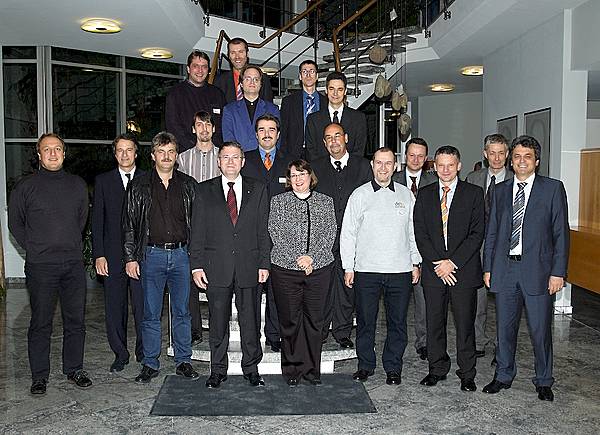
- OSADL founding members
A bit of OSADL's history and legal background
The OSADL eG is an international cooperative registered in Germany according to German public law which was adapted to the European Cooperative Law in August 2006. The OSADL eG was founded on December 8, 2005 and was assigned the register number 700048 (cooperative register) at the District Court of Mannheim, Germany. The OSADL eG was granted membership in the Baden-Württembergischer Genossenschaftsverband e.V., Heilbronner Straße 41, 70191 Stuttgart, Germany.
Briefly, the main organs of a cooperative are the General Assembly of the regular members, the Supervisory Board and the Board of Directors. The General Assembly elects several regular members to the Supervisory Board which, in turn, elects other regular members to the Board of Directors. A member may only be elected to one of the boards at a time.
Why a cooperative?
The fundamental idea of the cooperative movement is to create a community that "can do what is impossible for the individual alone" (Friedrich Wilhelm Raiffeisen). In doing so, the cooperative focuses not only on the benefit of its members but also on the benefit of the entire society. In the same way, for example, an agricultural cooperative allows farmers to work more effectively and to create more and better food for everybody, OSADL develops software on request of its members but makes it available to the rest of the world as Open Source software. Additional services such as engineering and legal support including installation, adaptation, certification and quality assessment are provided exclusively or highly discounted to its members. Since, apparently, there is a wide overlap between the underlying philosophy of the cooperative and the Open Source movement, it was decided to found the Open Source Automation Development Lab as a cooperative.


